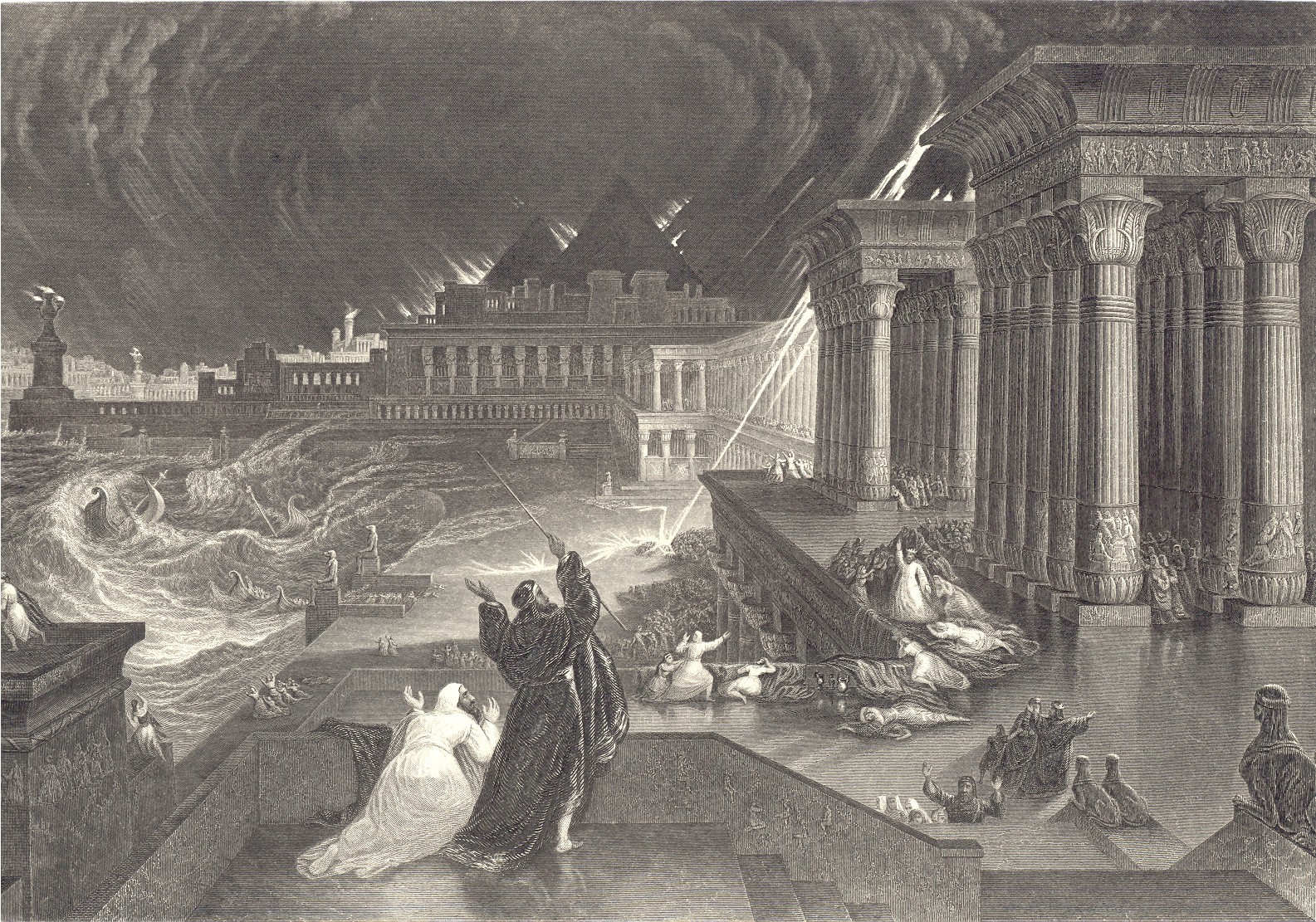
One Man Showed the Old
Testament Might Be
Accurate History After All
"Sit down before a fact as a little child, be prepared
to give up every preconceived notion, follow humbly
wherever and to whatever abysses nature leads, or you shall learn nothing."
Thomas Huxley (British biologist and "Darwin's Bulldog)
Then you will know the truth, and the truth will make you free."
Jesus Christ (Messiah)
There has been much confusion over the past two centuries regarding events described in the Hebrew Scriptures as they relate to the history of ancient Egypt. Most of this confusion has centered on the Exodus of the Israelites from Egypt. The Bible dates it to the fifteenth century B.C., while conventional history dates it to the thirteenth century. Christian and non-Christian scholars alike have come to accept the thirteenth century date, upheld on the authority of non-Christian scholarship; however, by conventional reckoning, either date places this momentous event, and the destruction of Egypt, in the reigns of either Thutmose III or Ramses II, Egypt’s two greatest pharaohs, during whose reigns no such momentous event took place.
This has rendered the Exodus story to the status of a fable, a myth, a legend, a nice Biblical story good for moral instruction, but not historically true. And Christian and Jewish scholars have grasped at the flimsiest of straws in trying to make the two histories fit.
But, does it end there?
In 1950, one man dared to suggest that it was true, and it was not only true, but historically verified by sources outside the Bible.
Immanuel Velikovsky was neither a scientist nor a historian. He was a medical physician and psychoanalyst, trained in the school of Sigmund Freud. Yet, he undertook a massive revision of the history of the earth and the solar system, and the publication of Worlds in Collision in 1950 caused a furor in the academic world that has subsided only in recent years but has never been resolved.
With the publication of Ages in Chaos in 1952, Velikovsky presented the first of five volumes of a reconstruction of the history of ancient Egypt which paralleled the Old Testament with amazing, unheard-of precision. Others ~ most notably Donovan Courville, John Bimson, David Rohl, Peter James, and Gunnar Heinsohn ~ have carried it on.
Velikovsky turned conventional twentieth century science upside-down and, more by the direction in which he pointed than the theory he proposed, pushed it in entirely new directions. Nearly six decades after publication of his first book, and nearly 30 years after his death, six journals have been devoted to his work and its awesome impact. More than twenty-five symposia, dozens of books, and hundreds of published papers have carried it on. The century’s leading scientific heretic spoke at two NASA installations and proposed tests the results of which helped achieve a truer understanding of our solar system. Universities offered entire courses on his theories; professors used his books in their classrooms; and his ideas, once dismissed as the ravings of a crackpot, have ~ for the past half century ~ been finding their way into conventional mainstream scientific thought.
Velikovsky upended the uniformitarian theory of the gradual, peaceful evolution of the earth and the solar system and returned us to catastrophism, on which all of science is now based. He dismantled the conventional history of ancient Egypt, a scheme to which the histories of all other ancient Middle Eastern civilizations are aligned; and, rather than rewrite the Bible, as conventional scholars continue to do, he rewrote Egyptian history instead, upholding the Scriptures as accurate historical documents. His followers are now dismantling the accepted history of the ancient Middle East and showing it to be the fabrication it really is.
He revealed the cosmic origins of ancient myths, customs, and beliefs that had long been dismissed by modern scientists as the vivid imaginations of our primitive and child-like ancestors, who were actually neither primitive nor child-like.
His work encompassed, and stimulated new directions of thought in, a vast number of academic fields, including archaeology, anthropology, geology, paleontology, astronomy, physics, celestial mechanics, religion and folklore. That alone is no mean feat, but he also showed us, as the Washington Evening Star put it, to "not be afraid to stake out new intellectual territory in defiance of fashionable thought." He dreamed of unraveling the mysteries of the universe, and he came closer than most. He sought answers to our most perplexing questions, discovered many, and inspired inquisitive followers to search for more.
"He shook the shoulders of our minds," Henry Bauer wrote in his history of the controversy, and it was true. For that, more than for his theory itself, he should be remembered as one of the most profoundly influential scholars of all time.
Velikovsky broke new ground in 1930 by correctly suggesting that pathological encephalograms could be used to diagnose epilepsy, suggesting that an epileptic fit resembled an electrical short-circuit; it was the first of an avalanche of successful predictions. He helped start Hebrew University in Jerusalem. Chaim Wizeman, Sigmund Freud and Albert Einstein were his colleagues and friends.
But his greatest work began in 1940 when he and a friend discussed the Dead Sea, which had been a plain in the time of Abraham but had turned into a lake by the time of the Exodus. Had a natural catastrophe altered the landscape? They discussed the plagues on Egypt: were they myth and legend, or did they really happen? If they were real, why was there no Egyptian record of them? Conventional scholars had long declared that no such record of the plagues existed, and Biblical scholars believed them. Velikovsky did not.
He soon discovered the record of a sage named Ipuwer describing many of the same things as Moses: the river turning to blood; the consuming fire; the massive destruction of trees and crops; the dense and prolonged night; crying throughout the land; the escape of slaves; and even the disappearance of the king.
Yet this document was not connected to the Exodus because A) scholars did not believe the plagues really happened; B) it was dated to an earlier epoch because of the miscalculated chronology; and C) it had been passed off by scholars as a collection of proverbs, a literary prophecy, or an admonition on profound social changes. Only Velikovsky saw it as a description of a great natural disaster. He sent a draft of the first chapter of his historical reconstruction to Professor John Garstang, excavator of Jericho. Garstang responded that the Bible and the papyrus appeared to describe the same event.
[For an in-depth discussion of this remarkable document, see The Papyrus Ipuwer, Egyptian Version of the Plagues, elsewhere on this website.]
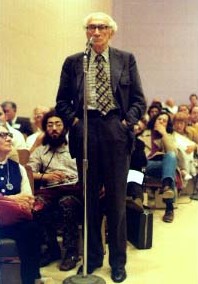
It occurred to Velikovsky (right) that, if these catastrophes really happened, then other ancient people must have recorded them as well. He searched on and found the same events (the plagues, the manna from heaven, the sun standing still, and other cosmic phenomena) described by ancient peoples all around the world. Down through the millennia, the ancients presented to him their historical evidence. Unlike his conventional colleagues, Velikovsky listened to what they had to say.
He released his findings in the 1950 publication of Worlds in Collision, in which he revealed that, according to eyewitness accounts, in the far distant past Jupiter convulsed and exploded a chunk of itself into outer space. That chunk became a comet which fell into an elliptical orbit around the sun. About 1450 B.C., the comet passed close to the earth, disturbing its rotation with its magnetic pull and enshrouding it in its gaseous tail. This, Velikovsky surmised, caused the plagues recorded by Moses and Ipuwer and launched the Israelites on their exodus from Egypt.
The comet circled the sun and returned at 52-year intervals, causing the sun and moon to stand still over Beth-horon as Joshua battled the Canaanites. The Mexican Annals of Cuauhtitlan record that "during a cosmic catastrophe...in the remote past, the night did not end for a long time." The American Indians remembered the sun and moon rising just over the horizon and remaining there for a very long time.
[What is always overlooked in the Joshua account ~ thought by skeptics to be entirely mythical ~ is that, immediately before the halting of the sun and moon, there was a shower of meteorites which killed more Canaanites than Israeli soldiers killed. Such a shower would never have occurred to a myth-maker, and meteorite showers always accompany the passage of a comet.]
More than once, as the comet came and went, the face of the earth was altered by global cataclysms. As the earth's crust folded, seas emptied onto continents and mountain ranges disappeared, only to be replaced by new ones. The earth was pulled out of its orbit and rolled over, the sun retreating across the sky to rise in the east instead of the west. The terrestrial axis shifted and the magnetic poles reversed. Climates changed drastically and some animal species suddenly became extinct, the woolly mammoths freezing where they stood, and land and sea animals alike being thrown convulsing into common graves.
Liquid fire (flaming petroleum) and red hot stones rained from the sky.
Frightened out of their wits, our ancient ancestors recorded these cataclysms by whatever means they had at their disposal. For the first time they became terrified of the heavenly bodies, and Jupiter replaced the sun as the chief deity in the skies. For generations, ceremonies and sacrifices were made every half century to the new fiery creature in the heavens to pacify her and prevent further devastation. Finally, on the night of March 23, 687 B.C., the comet encountered Mars in a three-way electromagnetic battle with the earth. An electrical blast from Mars (soon to be the new bloodthirsty god of war) charred Sennacherib's Assyrian army ~ 185,000 men ~ as it lay encamped around Judah. And the fiery daughter of Jupiter that caused it all was thrown into an orbit around the sun to become the new morning and evening star, Venus.
Can it be true? Venus, the most conspicuous planet in the heavens, sits peacefully amidst each sunrise and sunset. Yet ~ as quoted in Worlds in Collision ~ the Hindu table of planets from 3102 B.C., the Venus Tablets of Ammizaduga from the First Babylonian Dynasty, and the records of ancient Chinese, Brahman and Central American astronomers describe her movements as those of a comet. The Chinese reported that Venus spanned the heavens, rivaling the sun in brightness. The Chaldeans called Venus "the bright torch of heaven." The Toltecs called her Quetzal-cohuatl, "a feathered serpent." To the Mexicans she was "the star that smokes," their description of a comet.
Within historical memory people saw her explosive birth from Jupiter. According to both Hesiod and Homer, the goddess Pallas Athene (Venus) suddenly sprang from the head of Zeus-Jupiter; Aristocles said that Zeus had hidden the unborn Athene in a cloud and then split it open with lightning; in the sixth century, Pythagoras (of Pythagorean Theorem fame) told of the comet that was one of the planets but which appeared at great intervals of time and rose only a little above the horizon; and a Babylonian chronicler wrote, "the planet Venus receives the appellative: 'The great star that joins the great stars.' The great stars are, of course, the four planets Mercury, Mars, Jupiter, and Saturn...and Venus joins them as the fifth planet."
Velikovsky's theory of the comet that became the planet Venus has been legitimately challenged by a number of prominent scientists (Carl Sagan and Isaac Asimov not among them), but it was drawn from, and backed up by, testimony such as this from ancient civilizations around the globe as well as geological evidence from the four corners of the earth. It drew enormous ridicule and slander, yet produced a long series of successful predictions. That, however, is not the subject here.
Velikovsky considered his work to be a rewriting of the recent history of the Earth, and in so doing he published three of the five volumes on his revision of ancient Egyptian history. The major parts of his reconstruction (much better documented than his cosmic thesis) appeared in three volumes beginning with Ages in Chaos in 1952 and following up with Peoples of the Sea in 1977 and Ramses II and His Time in 1978. The Dark Age of Greece and The Assyrian Conquest remain unpublished, but are available online from The Velikovsky Archive.
And, as you read this little summary, bear in mind that 1) we are dealing with a civilization thousands of years old whose very scanty history was left to us in rags and tatters; 2) nineteenth century thinking was shaped by preconceived philosophical and anti-Scriptural prejudices; and 3) there is more than abundant documentation that could not be included here, but it is abundant, and the parallels are very real.
Ages in Chaos
Velikovsky had tried to make sense out of the confusion of ancient history; but, the more he tried to sort it out, the less sense it made. Finally, he realized that there was a massive error of about six centuries in the accepted historical chronologies of the ancient Middle East. Either Egyptian history was off by six centuries, or Biblical history was off. The conflict of chronologies was so acute that the modern perception of ancient history was thrown into complete confusion. Having put the pieces back together, Velikovsky visualized a state of historical chaos which he "modernized" to help the reader see what those studying bygone eras were up against:
| In order to
understand the scope of the displacements in the history of the ancient
world, one must try to conceive of the chaos which would result if a
survey of Europe and America were written in which the history of the
British Isles were some six hundred years out of line, so that in Europe
and America the year would be 1941 while in Britain it would be 1341. |
| As Columbus
discovered America in 1492, the Churchill of 1341 could not have visited
this country, but must have visited some other land ~ the scholars would
be divided in their opinion as to the whereabouts of that land ~ and met
its chief. Another chief, not Franklin Delano Roosevelt of Washington,
would live in history as co-signer of a charter with Churchill of Britain
in 1341. |
| But as American
records would speak of Churchill who crossed the ocean in the early
forties of the twentieth century, British history would also have a
Churchill II, six hundred years after the first one. Cromwell would also
be doubled by the same process. He would have to live three hundred years
before Churchill I and also three hundred years after him, or three
hundred years before Churchill II. |
| The First World
War would be fought twice, as would the Second. The First World War, in
its second variant, would follow the Second World War, in its first
variant, by five and three quarter centuries. |
| By the same
token, the development of the Constitution, the cultural life, the
progress of technology and the arts, would appear in chaotic distortion. |
| Newton in England
would become an early forerunner of Copernicus instead of following him.
Joan of Arc would revive the old traditions of the suffragettes of the
post-Victorian days; she would be burned twice with an interval of six
hundred years between; or, with the growing confusion of history, she
would have to return to the stake a few centuries from today to suffer her
death again. |
| In the case
presented, not only the history of the British Isles would be doubled and
distorted, but also the history of the entire world. Difficulties would,
of course, arise, but they would be swept away as oddities. Complicated
theories would be proposed and discussed, and if accepted, they would
establish themselves as new, strong obstacles to a correct perception of
past history. |
| Ancient history is distorted in this very same manner. Because of the disruption of synchronism, many figures on the historical scene are 'ghosts' and 'doubles.' Events are often duplicates; many battles are shadows; many speeches are echoes; many treaties are copies; even some empires are phantoms. |
Velikovsky now brought the ancient past up to scrutiny. The cataclysmic break between the Middle and New Kingdoms of Egypt, so well described by Ipuwer, perfectly matches the Exodus story recorded by Moses, and so he began his reconstruction there:
| The end of the
Middle Kingdom of Egypt, -1780 in accepted chronology, actually took place
in ca. -1450 ~ a difference of over 200 years. The following Hyksos period
endured, not 100 years, but over 400 years in close agreement with the old
Egyptian (Manetho) and Hebrew (Ages in Chaos, I, ch. 2) sources.
The beginning of the 18th dynasty (New Kingdom) falls not in -1580 but in
ca. -1050 ~ over 500 years difference. Thutmose III belongs to the second
part of the tenth century, not to the first part of the fifteenth.
Akhnaton belongs not in the first half of the fourteenth but in the middle
of the ninth century. Thus, as I showed in detail in vol. I of Ages in
Chaos, there exists an error of ca. 540 years through the entire
period covered by the 18th Dynasty. |
| Even more
important is that the dynasty of Seti the Great and Ramses II, termed the
Nineteenth Dynasty, did not follow the Eighteenth; the Libyan (Dynasties
22nd and 23rd) and the Ethiopian (Dynasties 24th and 25th) periods
intervened. The Libyan Dynasty of Sosenks and Osorkons reigned for 100
years only, instead of over 200; the Ethiopian Dynasty, however, is the
only one that in the conventionally written history of Egypt, maintains
its proper place. During the Nineteenth Dynasty the error of the accepted
Egyptian chronology reached the high figure of over 700 years; and
together with it the time of the contemporaneous rulers of the so-called
Hittite Empire is equally misplaced by over 700 years. Finally the
Twentieth Dynasty ~ that of Ramses III and his adversaries ~ Peoples of
the Sea ~ needs to be brought closer to our time by a full 800 years
and placed just a few decades before Alexander of Macedon. The
Twenty-first dynasty began under the Persian kings, continued
contemporaneous with the Twentieth ~ its rulers reigned in the Libyan
Desert oasis ~ and lasted until the second Ptolemy. |
Shifting Dynasties
Velikovsky’s solution to the chaos was to shift Egyptian dynasties
forward about five to six centuries, beginning with the Exodus of the
Israelites from Egypt in the mid-fifteenth century B.C. (Biblical date), and
to eliminate later Egyptian dynasties that were duplicates of earlier ones.
Pharaohs through the nineteenth Dynasty bear Egyptian names, while those from
the twentieth Dynasty on mostly bore Greek names; Velikovsky saw the
Greek-named pharaohs as repeats of the earlier Egyptian-named pharaohs, and so
eliminated the later dynasties.
When he was criticized for using literary sources like the Bible and
other ancient writings to date ancient events, he correctly pointed out that
ancient dates had all been derived from literary sources to begin with (holes
in the ground have no calendars). And Velikovsky solved one mystery after
another.
"The problem of the time of the Exodus in Egyptian history had never
been solved," he wrote. "In the Papyrus Ipuwer and the Naos of El Arish I
found descriptions of a natural upheaval very similar, sometimes identical,
with the description in the Book of Exodus... These parallels compelled me to
fix an unorthodox date for the Exodus. Collating the historical texts of
following generations for twelve hundred years, I could establish numerous
correlations between the histories of Egypt and of Israel which could not be
accidental; my reconstruction demonstrated that Egyptian history and the
histories of the nations which are written in harmony with it are out of line
with the historical past by about six to seven hundred years."
Velikovsky established the mid-fifteenth century ~ circa 1450 B.C.,
the Biblical date for the Exodus ~ as the proper date of the Exodus. The
Hyksos invasion of Egypt ~ conventionally dated to the seventh century B.C. ~
was thus connected to the Exodus, since Ipuwer’s papyrus actually describes
the Hyksos invasion but also contains many parallels to the plagues. In this
scenerio, the plagues destroyed Egypt, the Israelites left under the
leadership of Moses, the entire military might of the Egyptian Middle Kingdom
perished in the Red Sea, and the Hyksos invaded and conquered a now
defenseless Egypt.
Velikovsky identified the Hyksos as the Amalekites encountered by the
Israelites on their way out of Egypt, an unheard-of but sound identification.
There is no mention of Egypt in the Old Testament for half a millennium after
the Exodus. The lack of Egyptian interference during the Conquest of Canaan
and the era of the Judges can best be ascribed to the Hyksos domination of
Egypt which conventional history relegates to less than a century but which
ancient historians said lasted 500 years. There was no contact between Israel
and Egypt, in fact, until Solomon married the pharaoh's daughter, but greater
contact was soon to come.
Before long Solomon, renown throughout the Middle East for his wisdom,
received the most mysterious, the most glamorous, and the most misidentified
visitor of them all ~ the Queen of Sheba.
Velikovsky identified the Queen of Sheba as Hatshepsut, the Eighteenth
Dynasty Queen of Egypt whose voyage to the land of Punt ("Punt" was an early
Egyptian name for Palestine) exactly matches the Queen's voyage to Jerusalem,
including her pursuit of the riches and prosperity of Solomon's kingdom and
the gifts she and Solomon exchanged. The temple she built upon her return ~
the Most Splendid of Splendors at Deir el Bahari, which she referred to as
"another Punt" ~ was modeled after the Temple in Jerusalem and was totally
unlike any other structure ever seen in Egypt.
When Hatshepsut disappeared, her nephew Thutmose III ascended the
throne. The Napoleon of Egypt, Egypt’s greatest pharaoh and greatest
conqueror, had no love for either his aunt or her relations. And, with the
death of King Solomon and the division of the kingdom of Israel, Israel no
longer posed a threat. Thutmose III invaded Palestine, and it is he whom
Velikovsky identified as the pharaoh who sacked the Temple in Jerusalem after
Solomon's death. Nearly item by item, the Temple treasures described in Kings
and Chronicles can be seen pictured on Thutmose III's Karnak temple walls.
By its importance in the time of the Eighteenth Egyptian Dynasty,
Velikovsky placed the el-Amarna correspondence in the era of the mid-ninth
century and discovered a wealth of correlations to the Old Testament history
of the divided kingdom of Israel, including identifying several personages in
the text.
In his most provocative work, Oedipus and Ahknaton, he
identified Ahknaton (son of the solar disk, father of Tutankhamen) as the
historical original of the mythical King Oedipus, who murdered his father and
married his mother. Drawings from the time show Akhnaton and his mother
together in scenes hardly typical of mother and son, but vaguely typical of
lovers. And the surrounding historical details of the Akhnaton saga match
nearly perfectly the mythological details of the Oedipus myth, including the
fact (not revealed until 1957) that Tutenkhamen and Smenkhare were brothers.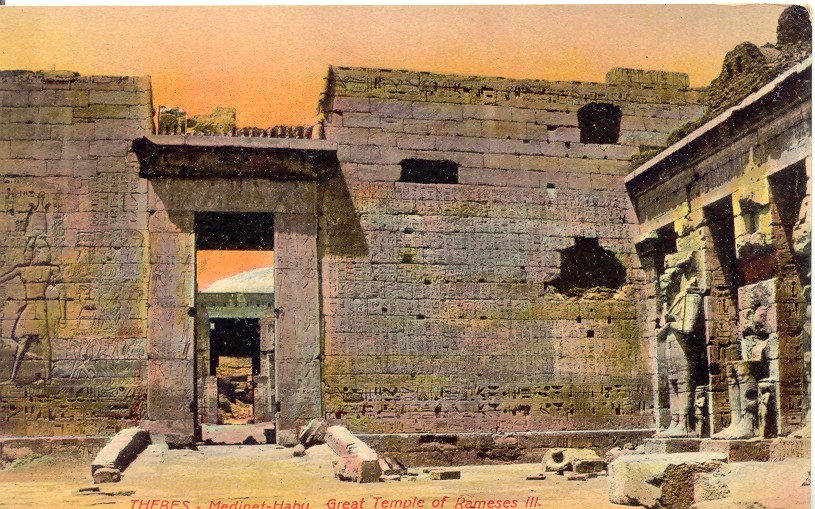
Among the mysteries conventional scholars could never solve was the
mortuary temple of Ramses III (right) at Tell-el-Yahudieh in the Delta. Ramses
III is conventionally assigned to the twelfth century B.C., and his mortuary
temple stands today as it was built at the time of his death. Velikovsky
identified Ramses III as Nectanabo I of the fourth century B.C. and, in his
Thesis on the Reconstruction of Ancient History, published in 1945, he
wrote, "The Greek letters of classical form incised on the tiles of Ramses III
during the process of manufacture (found at Tell-el-Yahudieh in the Delta)
present no problem. They are Greek letters of the fourth century.
"The inlay work and glazing of the tiles of Ramses III are innovations
introduced from Persia. And the hunting motifs in the art of Ramses III were
inspired by Assyrian and Persian bas-reliefs; some motifs of the Greek art
also made their influence felt in the murals of Ramses III."
This, in a temple supposedly built 700 years before these art forms
and classic era letters even appeared. Velikovsky did not make this up. This
information is taken from the archaeological report of the excavation of the
mortuary temple, and the confusion has not only perplexed scholars in
succeeding decades, it perplexed the two men who excavated the site and could
not agree on its proper date. One claimed a fourth century date because of the
evidence, and the other claimed a twelfth century date because that was when
Ramses III was declared to have lived.
This led Velikovsky to conclude the obvious: that Ramses III did not
live in the twelfth century, but in the fourth century.
The Battle of Kadesh
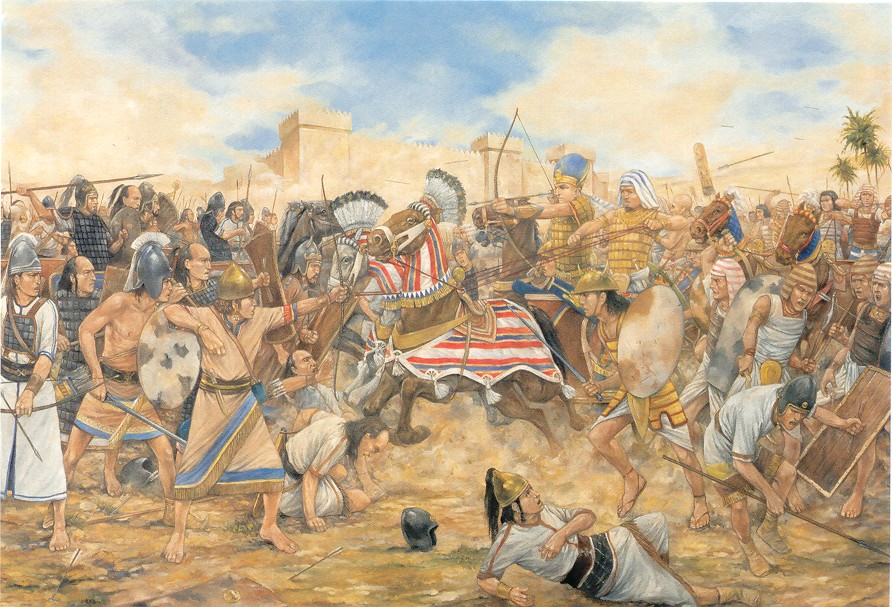 But, far and away, Velikovsky's most provocative discovery concerned
the greatest battle of antiquity, the Battle of Kadesh.
But, far and away, Velikovsky's most provocative discovery concerned
the greatest battle of antiquity, the Battle of Kadesh.
There have been, in world history, certain battles that had a major,
even world-wide impact, long felt through the ages.
The Battle of Hastings in 1066 AD allowed William of Normandy to lay
claim to the English throne, launched three centuries of Norman occupation of
England, Scotland, Wales, and later Ireland, propelled Great Britain toward
her place as a major world power, and marked the last time this nation would
be invaded by a foreign foe.
One of European history’s most decisive and far-reaching conflicts,
the Battle of Waterloo in 1815, ended forever the reign of terror imposed on
Europe by Napoleon Bonaparte, and marked the eclipse of French power and
signaled the ascendancy of the German Empire. Napoleon’s defeat was so
complete that the name Waterloo came to be a synonym for crushing defeat.
The Battle of San Jacinto in 1836 resulted in the defeat of Mexico’s
El Presidente, Santa Anna, and paved the way for the fledgling United States
to reach to the Rio Grande River in the south and the Pacific Ocean in the
west, thus becoming a continental power and eventually the most powerful
nation in the world.
The Battle of Gettysburg in 1863 turned back the last major
Confederate invasion of the Union and left Robert E. Lee’s Army of Northern
Virginia too weak to wage another major campaign, thus ensuring the eventual
reunification of the northern and southern states into one Union and America’s
place on the world stage of the fast-approaching Industrial Age and Twentieth
Century.
And, the Battle of Stalingrad in 1942-43, the bloodiest battle in
recorded history, was the major turning point in the war in Europe until
D-Day, resulted in the liberation of the Soviet Union from the Nazi invasion,
and propelled the Soviets to eventual victory in 1945, which in turn led to
the division of Europe by the Iron Curtain for more than 45 years.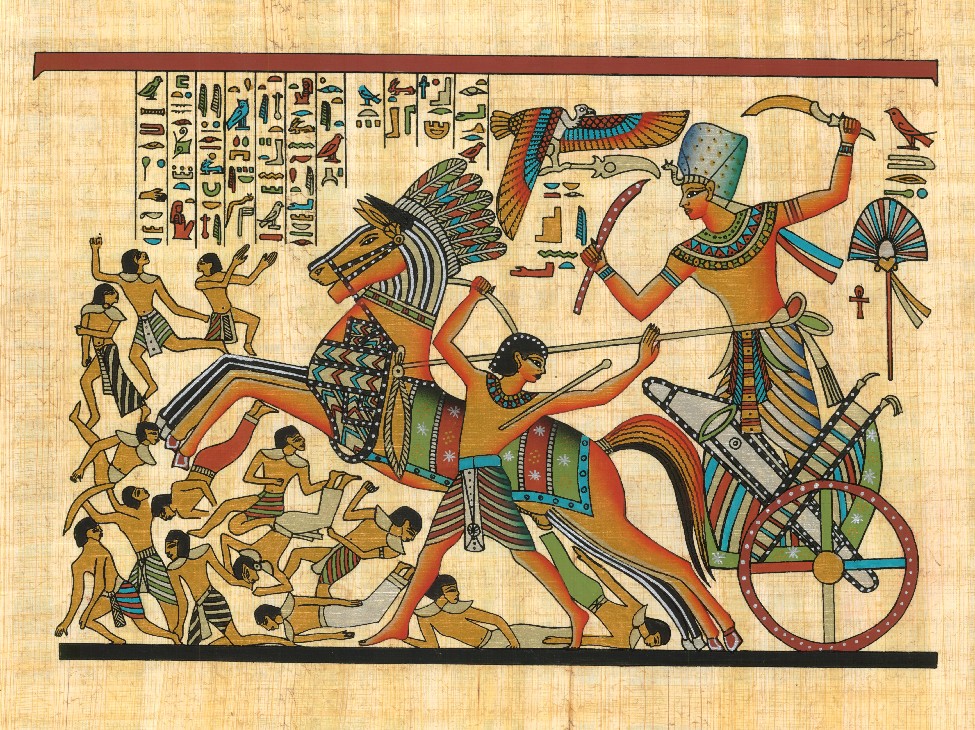
The Battle of Kadesh (right), variously dated about 1275 or 1285 B.C.,
was fought between the two greatest powers in the world and was called by Rob
Wanner "truly the mother of all battles, in every sense. Fought on the banks of
the Orontes River in Syria, this is the earliest battle of which true military
tactics are known...
"Few single battles in the history have determined the most powerful
empire in the world; the Battle of Kadesh was one. Control over the
Mediterranean, trade routes, large stretches of land, and massive populations
that could be mobilized for war all hung in the balance. In the period from
2000 B.C. to 1200 B.C., the indisputable most powerful civilizations in the
world were the Egyptians, the Hittites, and the Assyrians. Secondary players
in the same region were Amurru, a kingdom of united lands in coastal and
central Syria; Canaan, the coastal land south of the Orontes River; the
Hurrians of Mitanni in the east; and Babylonia. Whoever could maintain
favorable relations with them or could directly control them would have a
major advantage over the others. As rapid expansion of all three civilizations
came to a head, there emerged border disputes. All eyes eventually turned to
the narrow strip of land that connected Asia, Europe, and Africa, where
civilizations incorporated the rich networks of trade from east and west.
"With around 5,000 chariots involved, it may have been the largest
chariot conflict of all time. However, it also marked the high water mark for
both empires. The Hittite empire soon began its decline, and was destroyed;
and Egyptian influence in the eastern Mediterranean also declined."
It was a battle that changed the course of history. Yet, because of
the historical chaos, we have been deprived of the true drama of the showdown
between two of the very greatest monarchs in all antiquity because, according
to conventional history, ancient armies fought the same battle twice.
Check this out: By Ramses II's own account, he began to build a
canal connecting the Mediterranean Sea to the Persian Gulf. He suddenly halted
construction and invaded Palestine. His records tell us that he was forced to
fight a Palestinian prince who was mortally wounded by an
Egyptian dart-thrower (archer), and whose army was subsequently routed. Ramses
carried off the princes of Retenu (a New Kingdom designation for Palestine) as
"living prisoners" to Egypt. Ramses then plundered the chiefs of the Asiatics
in their own lands, returning every year to his headquarters at Riblah to
exact tribute.
Four years later, Ramses moved on Kadesh, north of Bab, along a river
designated variously in hieroglyphics as r-n-t, n-r-t, and
p-n-r-t. He set up camp by the fortress at Kadesh, which had a double wall
and moats, was surrounded on all four sides by water, and projected into a
large stream near a sacred lake. Ramses' army consisted of the divisions of
Amon, Ra, Ptah and Seth; Lydian mercenaries (hired men) were employed, and
chariotry took part in the battle. As the Egyptian army camped, Hittite King
Hattusilis, aided by his Syrian allies, came around from the south and
attacked. The Egyptian army panicked and fled to the north ~ away from
Egypt. (Ancient armies always retreated in the direction of their
homelands, so as not to sever their supply lines.) Ramses rallied his forces
and counterattacked, and a cease-fire the following day ended hostilities,
whereupon Ramses returned to Egypt with precious few spoils to show for his
efforts. He then spent the next few years subduing revolts in neighboring
provinces. All of this occurred, we are to believe, in the thirteenth century
B.C. (conventional date).
Six centuries later, in the seventh century B.C., the Greek historian
Herodotus tells us that Pharaoh Necho II began to build a canal to connect the
Mediterranean Sea to the Persian Gulf. Convinced he was building it for the
heathen, Necho halted construction and invaded Palestine. According to II
Kings and II Chronicles, Necho was challenged in the Megiddo Pass by Josiah,
King of Jerusalem. Necho requested that Josiah let him pass by, but Josiah
refused and in the ensuing battle was mortally wounded by an Egyptian archer.
His army was subsequently routed. Jehoahaz was made king of Jerusalem, but
Necho soon put him in chains, carried him off to Egypt, and replaced him with
Jehoiakim, who paid an annual tribute of 100 talents of silver and one talent
of gold.
Four years later, according to the Hebrew prophet Jeremiah, Necho
moved on Carchemish, north of Baw, on the Euphrates River. He set up camp by
the fortress at Carchemish, which ~ according to excavation reports ~ had a
double wall and moats, was surrounded on all four sides by water, and
projected into a large stream near a sacred lake. Necho's army consisted of
the divisions of Amon, Ra, Ptah and Sutekh; mercenaries from the Sardana, from
Sardis in Lydia, were employed, and chariotry took part in the battle. As the
Egyptians set up camp, Babylonian King Nebuchadnezzar, aided by his Syrian
allies, came around from the south and attacked. The Egyptian army panicked
and fled to the north ~ away from Egypt. Necho rallied his forces and
counterattacked, and a cease-fire the following day ended hostilities,
whereupon Necho returned in disgrace to Egypt with Nebuchadnezzar hot on his
tail. He then spent the next few years subduing revolts in neighboring
provinces.
Each campaign exactly matches the other, but wait! It gets better!
Some years later the antagonists signed a treaty ~ the first recorded
act of diplomacy in history ~ and they became the best of friends. Both copies
of this treaty survive, one in Egyptian hieroglyphics in Ramses’ temple, and
the other in Babylonian cuneiform on a tablet from a seventh century layer dig
at Boghazkoi. Both versions bear Ramses' name, for which reason the
cuneiform copy, and the dig at Boghazkoi, were dated to the thirteenth century
in spite of all evidence to the contrary, and the entire scenario was
duplicated.
 There is no record anywhere in Egypt of a pharaoh named Necho, even
though he was a great monarch who sent a sailing expedition around the African
continent and kept the Middle East in a state of turmoil for more than twenty
years; and no document outside of Egypt, except for the cuneiform treaty from
a late-century dig, mentions Ramses II, the second-greatest pharaoh in the
history of Egypt.
There is no record anywhere in Egypt of a pharaoh named Necho, even
though he was a great monarch who sent a sailing expedition around the African
continent and kept the Middle East in a state of turmoil for more than twenty
years; and no document outside of Egypt, except for the cuneiform treaty from
a late-century dig, mentions Ramses II, the second-greatest pharaoh in the
history of Egypt.
The site of Kadesh has never been found, though Ramses' description of
it is identical to the excavated site at Carchemish. The canal both men built
is still there, but with Ramses alone identified as its builder. And
Hattusilis is a biographical and psychological twin of Nebuchadnezzar.
Velikovsky's conclusion was that the most famous battle in all
antiquity pitted Ramses II, Pharaoh of Egypt, against Nebuchadnezzar, the King
of Babylon, and Nebuchadnezzar won.
* * * * * * * *
While astronomers foamed at the mouth at the mere mention of
Velikovsky’s name, historians were more sympathetic, particularly the leading
American historian, Dr. Robert H. Pfeiffer of Harvard University. Upon the
publication of Worlds in Collision in 1950, Pfeiffer wrote to
Velikovsky, "Allow me first of all to congratulate you, not of course for the
fact that your book has become ‘a run-away best seller,’ but for the
magnificent qualities of contents and form of your book. I read it with utter
fascination and absorption, being carried away by the cosmic drama which you
unfolded before me. I was amazed at the depth and vastness of your erudition,
which I have not seen equaled except possibly in O. Spengler’s Decline of
the West. Aside from expressing my admiration, I am unable to make any
valuable comments: my ignorance of astronomy, physics, chemistry, far-eastern,
and Aztec literatures, etc. is abysmal, complete. I shall have to sit on the
sidelines as you and the scientists discuss your theory about the comet which
eventually became the planet Venus."
Upon publication of Ages in Chaos in 1952, Pfeiffer wrote,
"Dr. Velikovsky discloses immense erudition and extraordinary ingenuity. He writes
well and documents all his statements with the original ancient sources. His
conclusions are amazing, unheard of, revolutionary, sensational. If his
findings are accepted by historians, all present histories for the period
before Alexander the Great (who died in 323 B.C.) must be discarded, and
completely re-written. If Dr. Velikovsky is right, this volume is the greatest
contribution to the investigation of ancient times ever written."
And Professor Etienne Drioton of the Service des Antiquités, and
General Director of the Cairo Museum, wrote to Velikovsky, "You certainly
overturn ~ and with what zest! ~ many of our historical assumptions, which we
have considered established. But you do it with a total absence of prejudice
and with impartial and complete documentation, all of which is most
gratifying. One might dispute your conclusions point by point: whether one
admits them or does not admit them, they will have posed the problems afresh
and obliged us to discuss them in depth in the light of your new hypotheses.
Your fine book will have been in every way very useful to scholarship."
When his revised chronology was, on occasion, put to the test, the
results were startling. Generally, Carbon-14 test results that did not conform
to conventional dating were discarded because, obviously, they had to be
wrong; but, on occasion, some were released. Among them, Carbon-14 dating
proved that Old and Middle Kingdom artifacts were several hundred years
younger than had been believed; and in 1958 National Geographic
reported that North and Central American civilizations were thousands of years
older than previously thought, both finds vindicating Velikovsky. Wood from
the foundation cribbing of a Hittite fortress at Alisar III was carbon-dated
with a divergence of 800 years from the conventional chronology.
Tutankhamen is linked to Mycenae by his grandparents, Amenhotep III
and Queen Tiy, whose scarabs were found at Mycenae and who received Mycenaean
products in Thebes. All are conventionally dated to the fifteenth and
fourteenth centuries, but uncontaminated material from Tutankhamen's tomb was
carbon-dated by Willard Libby, who invented the process. The date? The
eighth/ninth centuries B.C.
Velikovsky had long stated that Tutankhamen and Smenkhkare (who had
briefly ruled along with him) were brothers, which fit neatly into his Oedipus
theory. This was not generally accepted until Cyril Aldred announced in 1957
that blood tests had shown that Tutankhamen and Smenkhkare were, in fact,
brothers.
But, no other single event was as important to Velikovsky’s historical
reconstruction, or to classical studies in general, as the deciphering of the
Linear B script from Crete.
When scarabs from the Eighteenth Egyptian Dynasty were discovered at
Mycenae, its date was fixed to the fifteenth and fourteenth centuries B.C.
[All ancient sites in the Middle East are dated by Egyptian artifacts found
there.] Evans' discovery of the Linear B tablets at Knossos and Pylos
established a firm connection between Mycenae and Late Minoan Crete: fifteenth
and fourteenth century. No Mycenaean script survived past the destruction of
Mycenae (conventional date about 1200 B.C.), and the Greek alphabet did not
appear until the seventh century.
Because Mycenae is dated in the fifteenth and fourteenth centuries
B.C., and because Greece did not arise until the seventh century, between
Mycenae and Greece there is postulated a gap of six centuries, the "Dark Age
of Greece," about which virtually nothing is known. According to conventional
history, the entire Mycenaean civilization suddenly and completely
disappeared, and then ~ 600 years later ~ the Greek civilization just as
suddenly appeared, fully formed in all its glory, out of no where. However,
Homer, in the early seventh century or later, accurately described Mycenaean
practices and artifacts, and facts about the fall of Troy, which he could not
have known in such detail if the Dark Age had intervened. Oral tradition could
not have preserved them so accurately; and, within the bounds of poetic
license, Homer ~ like the Hebrew Scriptures ~ has never been proven by any
archaeological discovery to be historically wrong.
Among the most asinine statements historians made concerned
fifteenth-century Mycenaean artifacts found in seventh-century Greek homes.
Perhaps, the archaeologists concluded, farmers during the Dark Age had kept
the Mycenaean artifacts in their homes for 600 years. Archaeological reports
from the late nineteenth and early twentieth centuries are filled with this
kind of idiocy, forced upon intelligent and educated scholars by misaligned
historical chronologies and the blindness of those scholars in adhering to the
accepted paradigm in the face of factual and conflicting evidence.
Discovered at various sites beginning in 1900, numbering about 3,000
clay tablets consisting mostly of minutely detailed bureaucratic records of
petty commercial transactions, and dating (conventionally) from 1400 to 1240
B.C., the Linear B script had confounded scholars for half a century. By 1950,
no ground had been gained.
Because the Dark Age supposedly separated the two cultures, Evans
insisted that Linear B could not be Greek, and Homeric Greek authority Helen
L. Lorimer wrote in 1950, The result is wholly unfavorable to any hope
entertained that the language of the inscriptions might be Greek.
Velikovsky, however, synchronized Mycenae and Late Minoan Crete with
the 8th-9th century divided kingdom of Israel, immediately preceding the
appearance of Greece. He thus deduced that Linear B was Greek, and said
so before the Princeton University Graduate College Forum on October 14, 1953.
Just six months later, on April 9, 1954, the New York Times
announced that Michael Ventris and John Chadwick had deciphered Linear B. It
was Greek. Not only that, it had much in common with Classic Era Greek
dialects. Historians were aghast.
How, they asked, could a highly literate, cultured, and
productive society become wholly illiterate, uncultured, and unproductive so
quickly and remain so for half a millennium, and then suddenly reappear
~ brilliant, fully literate, and fully productive ~ as exemplified by Homer?
And How, when civilization was rampant throughout the
Mediterranean, could 600 years of history simply disappear so completely that
not one shred of evidence confirms its existence?
Civilizations do not completely lose their literacy and then regain it
centuries later, yet no scholar except Velikovsky has ever supplied a
satisfactory explanation. Velikovsky's answer was that the 600-year Dark Age
never existed, that Mycenae immediately preceded Greece, and that Homer in the
seventh century wrote of Mycenean things he saw and knew about first-hand.
Take Your Pick
So which is right: the Old Testament or the conventional history of
Egypt? They do not agree. The Hebrews were the first people to compose a
narrative history of their nation; but it was the fashion in the nineteenth
century to discredit ancient writings and deny the authorship of those
credited with writing them (i.e., Moses of the Pentateuch, Homer of the
Iliad and the Odyssey), so the Israelites have long been denied the
credit due them. Instead, nineteenth and early twentieth century historians
rejected the Old Testament outright as a collection of myths and legends
written down five centuries before Christ. Still, the long list of kings and
dynasties had no dates, and historians needed an anchor point in time on which
to pin the king-lists in order to rebuild the history of Egypt.
The Egyptian chronology is the basis for the chronologies of all
Middle Eastern nations, so it had to be a mighty trunk to support such a
wide-ranging tree. Yet, rather than consider the Old Testament sequences and
dating of events, historians looked elsewhere for an anchor; and, in
constructing the history of Egypt, here is the mighty piece of documentation
they chose over the Bible on which to hang the history of the ancient Middle
East:
| The list of
Egyptian dynasties comes to us from Manetho, a third century B.C. priest
and historian who lived in Sebennytos, the capital of Egypt, during the
thirtieth Dynasty, during the reigns of Ptolemy I and Ptolemy II. His
Aegyptiaca, a collection of three books about the history of Ancient
Egypt commissioned by Ptolemy II in order to bring together the Egyptian
and Hellenistic cultures, gave us a string of dynasties stretching back
more than 10,000 years. This formed the backbone of Egyptian history. |
| In the fourth
century A.D., Theon, father of the pagan priestess Hypatia, and a teacher
and one of the most educated men in Alexandria, Egypt, was a commentator
in the great library there. In the margin of one of his manuscripts an
unknown hand wrote in barbaric Greek, "From Menophres to the end of the
era of Augustus, or the beginning of the era of Diocletian, there were
1605 years." The era of Augustus ended about 284 A.D. That placed
Menophres in about the year 1321 B.C. |
Hang on! The plot now sickens!
| In vain,
historians searched Manetho’s king-lists for Menophres, who was no where
to be found. Desperate, they picked pharaohs whose transliterated throne
or royal names began with the letter "M": Mernere of the Sixth Dynasty,
Minnofirre of the Hyksos, Amenophes or Merrhes of the Eighteenth Dynasty,
and Ameneptas or Merneptah of the nineteenth. It was a grab-bag. |
| The two favored
candidates were Ramses I (throne name "Menpehtire") and Seti I (throne
name "Menmaatre"). No one could agree, so by default, and purely
arbitrarily, Ramses I was identified as Menophres on the bland
assumption that he founded the nineteenth Dynasty, which ~ if you believe
Manetho ~ he did not. His one-year reign was dated 1321 B.C., and both
Seti the Great and his son Ramses II followed. |
On that basis,
and on that alone, Ramses II landed in the thirteenth century B.C.
This, and this alone, is what historians chose over the "mythological" Old
Testament to be the anchor point for the conventional history of ancient
Egypt.
Using records of moon festivals, and relying on controversial readings
of ancient papyrus dates relating to 1460-year cycles between first risings of
Sirius before the rising sun on the Egyptian New Year (called the Sothic
Period), dates were assigned to other dynasties fore and aft.
If names which Manetho did not have were found on monuments, they were
inserted in likely places.
The edifice of Egyptian history was
complete. The histories of other surrounding nations, including Israel, were
rewritten to conform to it. Archaeological digs, no matter where, are still
dated by Egyptian artifacts found there.
So, it is entirely correct to say that on that one inscription in the
margin of Theon's manuscript rests the entire history of the ancient Middle
East.
But now for the difficulties:
| Manetho's
king-lists are a mess. Because he was trying to prove to the Greeks how
very ancient the Egyptian civilization was, contemporary dynasties in
Upper and Lower Egypt, or overlapping kings and dynasties, were all laid
end-to-end, and his history goes back more than ten thousand years.
Furthermore, major portions of the lists are entirely fictitious, and the
whole compilation is mangled and sloppy. Not only that, we don't even have
the original Aegyptiaca. It is left to us through the writings of
Africanus, Syncellus, Eusebius and Flavius Josephus, who mostly don't
agree. The Aegyptiaca was extensively commented on, adulterated,
and falsified for political and religious motives, and these false
renderings were often the sources from which later writers quoted him.
Scholars recognize Manetho’s difficulties, but can do nothing about it. Ramses I is not listed by Manetho in the nineteenth Dynasty, and Manetho would have been the only source available to whoever wrote that inscription on Theon’s manuscript. |
| And, finally, it
is now generally agreed that "Menophres" did not refer to a king at all,
but to Memphis, the Old Kingdom capitol of Egypt. Men-Nofre was the
ancient Egyptian name for Memphis. |
| One of the two
storage cities the Israelites built early in their enslavement was Raamses,
which historians obviously linked to Ramses II. However, there was an
entire early Middle Kingdom (about the 18th century B.C.) dynasty of
Raameside pharaohs from whom Raamses could have derived its name, so there
is no legitimate reason to link Raamses to Ramses II. |
| In 1883, Swiss
archaeologist Eduoard Neville excavated what he thought was the storage
city of Pi-Thom, and found Ramses II's name inscribed all over the place.
Neville concluded that Ramses II was Pharaoh of the Oppression, and his
son Merneptah the Pharaoh of the Exodus. The Exodus date was then
shifted to the thirteenth century to accommodate Ramses. However,
within thirty years, and well before the First World War, it was
determined that the site Neville excavated was not Pi-Thom at all, but
some other town, so any assumption that Ramses II was Pharaoh of the
Oppression or the Exodus is wholly unfounded. Ramses II has not one
archaeological link to the thirteenth century, although he has several
unexplained archaeological links to the seventh. Remember that, the next
time you read in a Bible handbook or commentary that the Exodus is
archaeologically linked to Ramses II (Halley) or that it took place in the
thirteenth century B.C. (Tyndale). |
| No historian today upholds the Menophres inscription because of its spurious nature and because most now agree that "Menophres" referred to Memphis. Sothic dating, by which other dates were achieved, was finally abandoned in 1985 because hieroglyphic inscriptions are often undecipherable. Besides, the length of the year appears to have changed several times in antiquity, rendering retrocalculation meaningless. Velikovsky showed that "Sothis" in the papyri referred to Venus, not Sirius. And Sothic Dating was unknown to the Egyptians anyway. |
The
conventional history of Egypt remains engraved in stone, a huge monolith of
epic size but little substance. Like the theory of evolution of species, it
hangs on by the skin of its teeth; but those who are hard at work dismantling
it are achieving a wider and more profound respect among conventional
archaeologists and historians who have tried to refute them and failed. And
they are no longer published in private papers and Velikovskian journals
alone; they are now being published in such conventional voices as The
Journal of Near Eastern Studies and Biblical Archaeology Review.
Why is this important?
Scripture places the Exodus in the fifteenth century B.C., 480 years
before Solomon began building the Temple in Jerusalem (I Kings 6:1); but this
is the conventional date for the reign of Egypt's greatest pharaoh, Thutmose
III. The conventional date for the Exodus is the thirteenth century based
solely on the erroneous connection with Ramses II, Egypt's second-greatest
pharaoh. Neither of these two great rulers was troubled by such a disaster as
the plagues (which totally destroyed Egypt) or the Exodus, and Bible scholars
clutch at straws trying to fit the terrible holocaust described by Moses into
these two extremely successful reigns. The claim that pharaohs did not record
their defeats, so often used as an excuse for lack of documentation during
these two pharaohs’ reigns, is wholly erroneous. They recorded their defeats,
but extolled their own valor over that of their armies.
The Exodus was to be God's memorial to us for as long as men inhabit
the earth; but, because of the historical confusion generated by misplaced
dynasties, many believe that the plagues never happened and the Exodus story
is a lie. God's great memorial has become a Sunday School fable, good for
moral instruction but of no historical significance, because academics biased
against the Lord and against the Scriptures tell us to believe them and
not the Word of God, even though it's the history and science books, and not
the Bible, that are continually being rewritten!
Ken Ham, President of Answers in Genesis USA and Joint CEO of Answers
in Genesis International, is a well-known Young Earth Creationist who declares
that Sunday School teaching has ruined Christians in their attempts to defend
Scripture. He declares that Christians are taught neat little Sunday School
lessons from Genesis without the scientific and historical evidence to back it
up, which has rendered too many Christians impotent in intellectual debate on
Creation. Add to that the historicity of the entire Old Testament, and you see
Ham’s point: Christians rely on the moral and spiritual lessons from the Old
Testament but cannot defend it against secular science and history.
Velikovsky may have been wrong about the role Venus played in those
ancient dramas. We really don't know, and there is strong evidence that Venus,
while obviously a former comet and a young planet, was not the culprit
Velikovsky thought it was. Many of his readings and interpretations have been
legitimately challenged since, as a psychoanalyst, he sometimes wrung more
interpretation from a source than it really had to give. He may have missed on
some of his cultural connections or even specific historical events. But,
then, nobody is always right; and, after all, he didn't write a Bible.
He also shot himself in the foot by publishing his reconstruction
piecemeal rather than all at once, and only three of the five volumes at that.
A full 25 years separated Volumes 1 and 2, by which time few people cared.
But overwhelming space age confirmation of his celestial predictions
and subsequent terrestrial discoveries compelled both interest from the
open-minded and wrath and condemnation from the bigoted who would rather
destroy him than listen to what he had to say, even though what he said in
1950 is standard thinking today. His breadth of view alone was staggering,
since in this age of extreme specialization no single expert has the broad
interdisciplinary knowledge to dispute him.
"How could one man be so right about so much?" someone asked. Good
question!
Finally, his historical reconstruction is important because it makes a
glaring statement about academic bias and misinterpretation, and about the
willingness of Christians and Jews to allow ungodly men to rewrite their
Scriptures. His work revealed the earth’s cataclysmic historical past,
which the Bible fully describes, and he demonstrated the reality of
Biblical events that are also described in the written records of other
ancient civilizations. In fact, whenever it has been put to an archaeological
test, the Bible ~ both Old and New Testaments ~ has never been proven wrong,
and has been consistently upheld against secular history books. All the
theories of the composition of the Old Testament were put forth before the
rise of archaeology. Unbelievers still spout them, but archaeology is the
skeptic’s greatest enemy.
People turn pale at the thought of cometary impacts 3,000 years ago,
or the history of Egypt being wrong. But they aren't scared when they scratch
for rare hints of the Exodus in the accepted time slots, and they aren't
overly bothered when ungodly scholars tell them not to expect or look for
historical confirmation of Biblical events. Christians and Jews have blindly
accepted the lie that the Scriptures have to be taken almost totally on faith
in the face of overwhelming historical difficulties, if not outright
refutation, and that all we can realistically expect from the Bible is sound
moral guidance.
That is the biggest vat of snake oil anybody ever bought. If the Bible
is the Word of God, then its history will be accurate and true. And Velikovsky
was the first non-Christian scholar to say so. And, even if it isn’t the Word
of God, it is still accurate history and describes real historical events.
As Velikovsky told Carl Sagan, "Whatever happened, happened."
And he made it clear, even if only by the respect he gave the
Scriptures as historical documents, that we who believe the Bible to be the
inspired Word of God have no need to bow down to the sacred cows of secular
history and science. Considering the perfect archaeological batting record
which both the Old and New Testaments have over conventional science and
history books, and considering the wholly vacuous base on which the
conventional history of ancient Egypt rests, perhaps it's about time we do
what Velikovsky did and rewrite the one that needs to be rewritten.
Unpublished work © 2006 Henry Zecher
[Photo of Immanuel Velikovsky courtesy of Ev Cochrane, Editor and Publisher of
Aeon, Ames, Iowa]
